
The term mantra originates from the Sanskrit roots “manas” and “tra,” literally translating to an instrument of thought designed to shield the mind from chaotic fluctuations. These sacred sound formulas, first perceived by ancient Vedic Rishis as cosmic vibrations, serve as precise mental tools for achieving deep concentration and spiritual protection.
Many practitioners struggle to maintain focus during meditation or feel overwhelmed by persistent cognitive noise. This article explains how the rhythmic repetition of a mantra can harmonize your internal frequency and provide a practical framework for integrating these ancient sounds into your daily routine.
- Defining the Mantra Meaning and Its Sanskrit Origins
- Spiritual Traditions and the Diverse Use of Sacred Sound
- Structural Mechanics and the Precision of Vedic Chants
- Psychological Shifts and the Physiological Impact of Repetition
- Modern Application and the Integration of Daily Mantras
Defining the Mantra Meaning and Its Sanskrit Origins
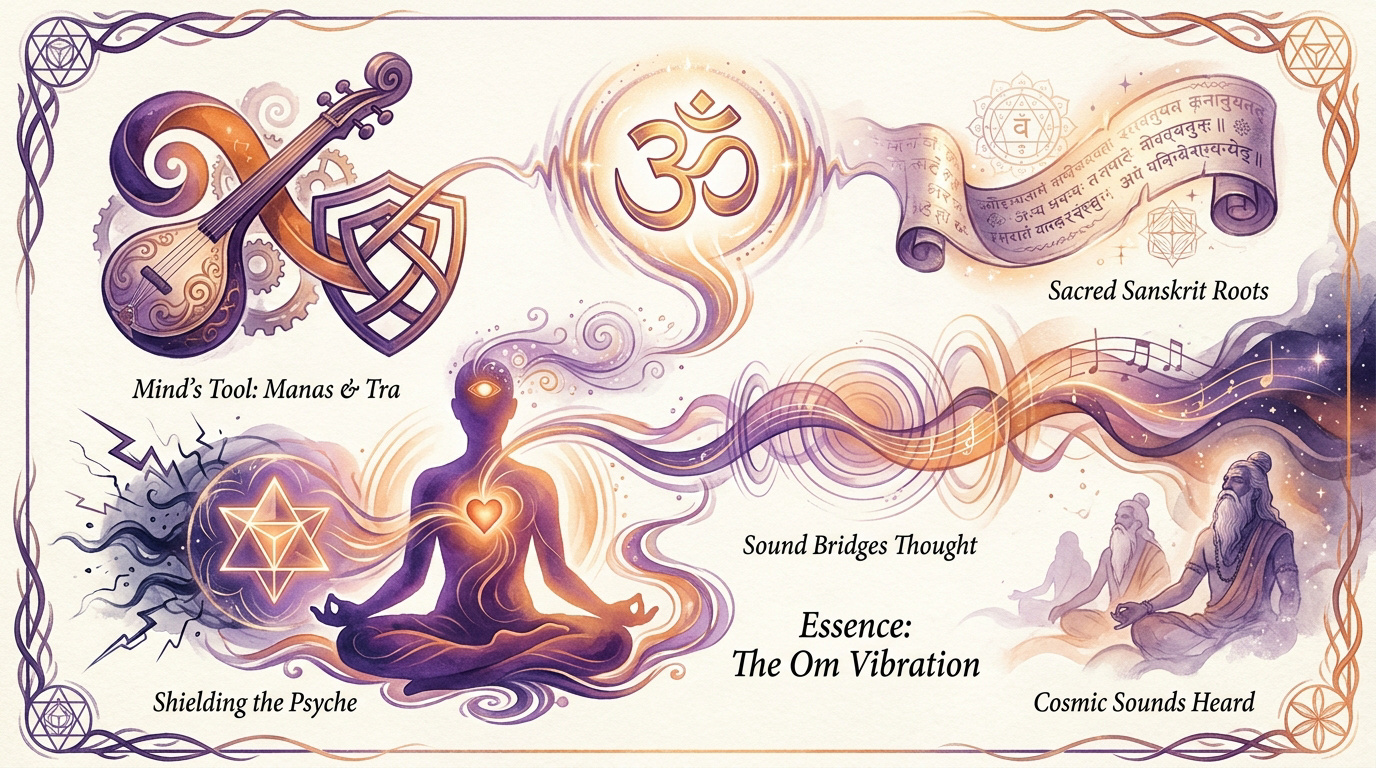
A mantra is a sacred sound formula originating from Sanskrit “manas” (mind) and “tra” (tool), serving as a mental instrument for protection. These ancient Vedic vibrations bridge thought and audible frequency to shift consciousness.
The linguistic breakdown of these syllables reveals how they function as literal tools for the human psyche.
Manas (mind) + Tra (tool/instrument). Literal translation: Instrument of thought or mental tool for protection.
Etymological Roots of the Mind and Its Tools
The Sanskrit term mantra stems from the root “man,” which means to think. Combined with the suffix “tra,” it denotes instrumentality. Thus, it translates literally to an instrument of thought.
This formula shields the mind from chaotic thoughts. It acts as a linguistic anchor, preventing mental drift. This creates a stable internal environment for the practitioner. It functions as a protective psychic barrier.
These concepts relate to the Sanskrit origin of mantra. Historical records trace its first appearance to Vedic traditions. This establishes the profound antiquity of the practice.
Sound as a Sacred Vehicle for Consciousness
Practitioners experience a transition from silent thought to audible vibration. Sound is seen as a bridge. It moves the practitioner from the physical to the metaphysical realm through frequency.
Ancient Rishis, or sages, heard these cosmic sounds during deep meditation. These vibrations were not invented but discovered. They codified these frequencies into specific linguistic formulas for the benefit of humanity.
The syllable Om remains the essence of the Vedas. It represents the absolute reality of the entire universe. It is the primordial sound from which everything emerges.
Distinguishing Spiritual Formulas From Secular Slogans
Contrast traditional chanting with modern motivational phrases. Secular mantras are often just psychological cues. They lack the specific vibrational lineage found in sacred sounds and ancient Vedic lineages.
Sacred formulas aim for transcendence or deity connection. Secular slogans target behavioral change or confidence. Both use repetition, but their energetic signatures differ greatly. The intent behind each practice is fundamentally distinct.
The common usage of mantra now includes commercial slogans. This evolution shows the word’s massive cultural impact. However, the spiritual depth remains a distinct and separate category.
Spiritual Traditions and the Diverse Use of Sacred Sound
The etymological roots provide the foundation, but the application of these sounds varies significantly across the great Eastern lineages.
Deity invocation for transformation and the cultivation of compassion through the jewel in the lotus.
Universal peace through honoring virtues and communal remembrance of the Divine to transcend the ego.
Vedic Foundations and Hindu Deity Invocations
Sound serves as a direct bridge to connect with specific energetic frequencies. In the Hindu tradition, every sacred vibration corresponds to a particular deity. Chanting these formulas invokes those divine qualities within the practitioner.
For instance, practitioners turn to Ganesha to ensure success or Shiva for profound transformation. You might explore How to use a powerful Ganesha mantra for marriage success for practical application. These precise spiritual tools align the individual with celestial archetypes.
The Mahamrityunjaya Mantra holds a central place in this heritage. It is dedicated specifically to Lord Shiva. This prayer provides protection and helps the devotee in overcoming deep-seated fears.
Buddhist Perspectives on Compassion and Enlightenment
Buddhism utilizes the power of chanting primarily for purification and achieving mental clarity. The practice uses sound as a solvent to dissolve the ego. This process facilitates a transition toward a state of emptiness.
The Lotus symbol remains a cornerstone in Tibetan traditions. The ubiquitous “Om Mani Padme Hum” invokes Avalokiteshvara, representing the jewel within the lotus. It signifies that the potential for enlightenment exists within every sentient being.
Many practitioners testify to the healing power of Buddhist sound. It effectively purifies emotional energies. Ultimately, it acts as a gateway to access much higher energetic dimensions.
Jain and Sikh Approaches to Repetitive Chanting
Jainism emphasizes a profound focus on universal peace and non-violence. The Navkar Mantra is the central pillar of this faith. It honors the virtues of liberated souls rather than praising a creator.
Sikh chanting emphasizes the communal aspect of spiritual practice. “Naam Simran” involves the constant remembrance of the Divine through repetition. This is frequently practiced in groups. Such gatherings foster a powerful sense of collective resonance.
The Navkar Mantra significance lies in its structure of bowing to five categories of masters. This practice reinforces the values of humility and discipline. It remains a fundamental exercise for spiritual growth.
Structural Mechanics and the Precision of Vedic Chants
Beyond the tradition, the actual construction of these chants follows a mathematical and energetic logic that is surprisingly rigorous. The structure of a mantra serves as a technical blueprint for consciousness.
Seed Syllables and the Power of Beeja Vibrations
Beeja mantras represent the most fundamental layer of sacred sound. These are single-syllable sounds like “Hrim” or “Klim” that lack any formal dictionary definition. They function as pure energetic frequencies.
These vibrations impact the energetic body by acting directly on specific chakras. Proper pronunciation remains vital for efficacy, as sound and fire energy are linked. You can explore how Linga mudra benefits: boost fire and immunity to understand this thermal-acoustic relationship.
The importance of guru transmission is paramount for these specific sounds. Incorrect pronunciation can be counterproductive rather than helpful. The vibration must be exact to resonate correctly.
The Role of Meter and Rhythmic Resonance
Vedic recitation relies on absolute mathematical accuracy to be effective. The rhythm is just as significant as the sound itself. This structural framework is known as “Chhandas,” or the sacred meter.

Rhythmic patterns matter because they create a specific resonance in the physical atmosphere. Ancient rituals used these precise timings to ensure the desired outcome. The timing must be perfect to trigger the intended effect.
| Component | Function | Spiritual Impact |
|---|---|---|
| Seed (Beeja) | Primordial sound germ | Awakens latent potential energy |
| Meter (Chhandas) | Rhythmic structure | Shapes the vibration’s form |
| Deity (Devata) | Cosmic consciousness | Invocates specific divine essence |
| Meaning (Artha) | Linguistic intent | Aligns the mind with the sound |
Literal Meanings Versus Pure Sound Constructs
It is useful to compare linguistic phrases to pure frequency. Some mantras tell a story or offer a specific prayer. Others exist solely as vibrational sequences designed to bypass the intellect.
These formulas bypass the analytical mind to reach the subconscious directly. Sound does not require the mind to translate it to be effective. This process allows practitioners to enter a deeper state of meditation.
The Gayatri Mantra translation serves as a perfect example of this duality. It is a prayer for illumination and wisdom. It successfully combines linguistic meaning with a rigorous sacred rhythm.
Psychological Shifts and the Physiological Impact of Repetition
While the spiritual mechanics are profound, modern science is beginning to catch up with how these sounds physically alter the human brain.
Rhythmic Chanting as a Catalyst for Neuroplasticity
Repetitive chanting significantly modifies neural activity by shifting brain waves. This practice frequently induces alpha or theta states. Such frequencies are linked to deep relaxation and enhanced creativity.
Steady vocalization regulates the nervous system, which lowers stress levels significantly. This process effectively reduces cortisol production. Understanding neurasthenia and its impact on modern health demonstrates how chanting addresses modern fatigue and nervous exhaustion.

Research indicates that regular practice leads to measurable physiological improvements. These changes support long-term mental health and cognitive resilience through the following benefits:
- Lowered heart rate
- Improved focus
- Reduced anxiety
- Increased gray matter density in the hippocampus
Scientific observations confirm a shift to alpha/theta brain waves and a measurable reduction in cortisol levels during mantra meditation.
Transitioning From Cognitive Noise to Meditative Focus
The Default Mode Network (DMN) governs our internal mind-wandering. This specific brain network remains active during rest or self-referential thought. Chanting helps quiet this network effectively.
The concept of “Nada Brahma” posits that the entire universe exists as vibration. By chanting, practitioners aim to align their personal frequency with this universal energy. This alignment fosters a sense of profound harmony.
This rhythmic synchronization often facilitates a necessary emotional release. Mastering Mushti Mudra for emotional release and digestion shows how combining sound with specific gestures maximizes these healing effects.
Modern Application and the Integration of Daily Mantras
Understanding the theory is one thing, but the true power of a mantra is only realized through consistent daily practice and integration.
Japa Meditation and the Function of Mala Beads
Practitioners engage in the tactile practice of Japa by using a string of 108 beads. This rhythmic movement allows one to keep count of repetitions effortlessly. It eliminates mental strain during meditation.
Using a Mala with 108 beads for Japa meditation helps maintain focus and count without mental effort.
The grounding effect of touch provides a necessary physical anchor for the practitioner. Moving each bead manually prevents the mind from drifting toward external distractions. This specific combination of sacred sound and physical touch proves remarkably powerful for deep concentration.
Many Eastern traditions emphasize the significance of the number 108. It remains a sacred figure representing the universe and the totality of existence.
Guidelines for Choosing or Creating a Personal Mantra
To select an effective mantra, choose a phrase that resonates deeply with your current personal goals. It might focus on peace, health, or mental clarity. Resonance is the primary factor.
Traditionalists often suggest receiving a mantra from a guru through formal initiation. However, personal affirmations remain effective for modern mindfulness practices. The key to success lies in consistency and sincere intent during every repetition.
You can also explore Yoga Mudras: The Secrets of Sacred Gestures for Energy to combine sacred sounds with specific hand positions.
Synergies Between Sound and Visual Meditation Tools
Integrating mudras and mandalas provides visual and physical counterparts to the spoken mantra. These elements work together to create a multi-sensory experience. This approach engages the body and the eyes simultaneously.
When you engage sight, touch, and sound together, the mind finds no room for unwanted distraction. This synergy creates total immersion. It significantly accelerates the shift into a deep meditative state for the practitioner.

The following combinations can enhance your daily ritual:
- Use Gyaan Mudra for wisdom
- Focus on a Yantra for visualization
- Chant during Pranayama like Nadi Shodhana
For those looking to refine their breathwork alongside sound, see Nadi Shodhana Pranayama: Purifying the Energy Channels.
By mastering these sacred sound formulas, you transform your consciousness from chaotic noise into a focused instrument of thought. Begin your daily practice to regulate your nervous system and unlock profound mental protection. Consistent repetition will soon align your personal frequency with universal harmony for lasting inner peace.