
The Greek root pneuma, meaning breath or spirit, serves as the linguistic foundation for various respiratory terms used in modern clinical settings. This ancient heritage explains why the letter p remains a mandatory yet silent component of the word’s orthography, acting as a visual marker of its historical evolution.
Many writers struggle with the silent consonant cluster or confuse the term with chemically related words like ammonia. We will examine the precise nine letter structure and provide practical memory aids to clarify how to spell pneumonia correctly while understanding its medical significance.
- How to Spell Pneumonia and Its Clinical Definition
- Why Does the Silent P Exist in Medical Greek?
- Pronunciation Tips and the Ammonia Spelling Trap
- 3 Memory Hacks for Complex Respiratory Terms
How to Spell Pneumonia and Its Clinical Definition
Pneumonia is spelled with a silent ‘p’ followed by ‘n-e-u-m-o-n-i-a’, a nine-letter sequence originating from the Greek word for breath. This respiratory infection triggers lung inflammation, causing air sacs to fill with fluid, which distinguishes it from simpler bronchial irritations.
Pneumonia: an infection inflaming the lung’s alveoli (air sacs), which may fill with fluid or pus, causing cough, fever, and breathing difficulties.
Understanding the linguistic roots of this condition helps clarify its complex spelling and anatomical impact.
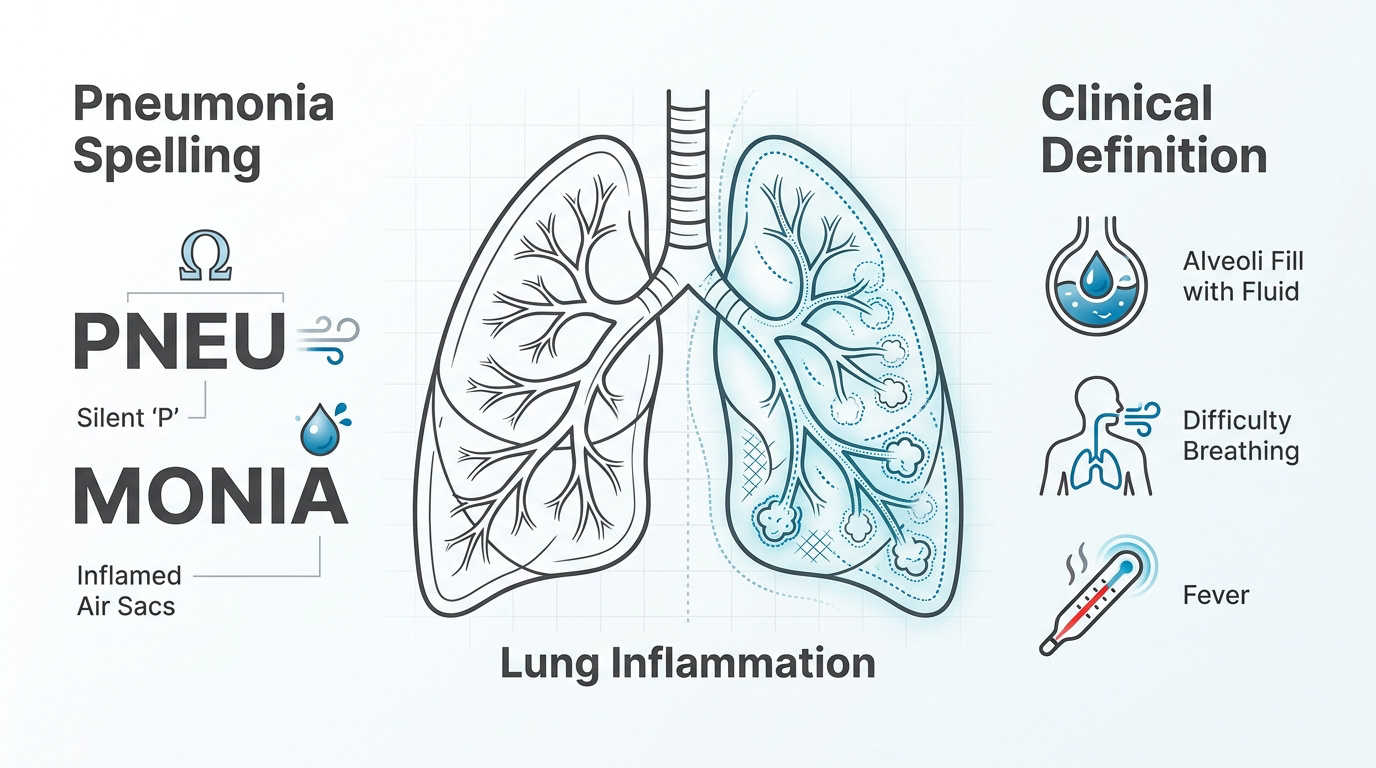
Breaking Down the Nine-Letter Structure
The correct sequence is P-N-E-U-M-O-N-I-A. You must start with the silent ‘p’ followed by ‘n-e-u’. This prefix is mandatory for medical accuracy. The word then concludes with the ‘m-o-n-i-a’ suffix.
Many writers mistakenly produce “pneumona” by skipping the second ‘i’. This vowel is vital for the word. It maintains the correct three-syllable phonetic structure. Missing it is a frequent orthographic error.
Visualizing the word helps: PNEU-MON-IA. The first cluster comes from the Greek for lung. The middle part connects to the ending. This distinction prevents common letter inversions.
Core Definition and the Inflammatory Response
Pneumonia is an infection that inflames the alveoli in one or both lungs. This inflammation disrupts normal oxygen exchange. It remains a serious condition beyond a standard cold.
The infection causes an accumulation of pus or fluid. This buildup triggers coughing, fever, and breathing difficulties. It creates a physical blockage within the respiratory system.
The condition ranges from mild to life-threatening. Severity depends on age and health. Knowing how to spell pneumonia helps in identifying medical reports and required treatments.
| Feature | Pneumonia | Pulmonary Edema |
|---|---|---|
| Primary Cause | Infection | Non-infectious |
| Fluid Type | Pus or inflammatory | Watery fluid |
Why Does the Silent P Exist in Medical Greek?
While the spelling seems modern, its roots are buried deep in ancient linguistic traditions that explain those awkward silent letters.
Root word: Greek ‘pneuma’ (breath/spirit). Related terms: pneumatic, pneumothorax. The ‘p’ became silent in English phonetic evolution.
Etymological Journey From the Greek Pneuma
The term originates from the Greek word “pneuma”. In its original context, this meant breath, spirit, or wind. It serves as the foundation for many respiratory terms used in clinics today.
This root connects directly to other common words. One might recognize “pneumatic” or “pneumothorax” as linguistic cousins. Such examples demonstrate a consistent pattern in medical English derived from Greek origins.
English scholars decided to preserve the initial ‘p’. They kept the original spelling to honor the word’s history. This created the “pn” cluster that complicates how to spell pneumonia for modern writers.
Evolution of the Silent Consonant Cluster
Phonetic shifts altered the word’s sound significantly. In Ancient Greek, speakers actually pronounced the initial ‘p’. However, English speakers found the “pn” sound difficult to articulate at the start of a word.
English differs from other languages in this regard. Some languages still retain a slight breathy sound for the ‘p’. In English, the pronunciation jumps straight to the ‘n’ sound without hesitation.
We keep the letter as a visual marker. It acts as a fossil within our alphabet, preserving the long history of the term.
Pronunciation Tips and the Ammonia Spelling Trap
Mastering the history is one thing, but saying the word correctly and avoiding common lookalikes is where the real practical skill lies.
Phonetic Breakdown for Everyday Usage
The phonetic spelling is “noo-MOHN-yu”. You should break it into three distinct beats. This helps beginners say it without stumbling over the invisible ‘p’.
The vocal emphasis is vital. The stress falls on the second syllable. Practice saying it out loud to build muscle memory for medical conversations or exams.
The initial letter is silent. You must remind the reader that the ‘p’ is seen but never heard. It is exactly like the ‘k’ in “knee” or “knife”.
Avoiding Confusion with Similar-Sounding Terms
The “ammonia” trap is common. Both words end with a similar “nia” sound. However, their meanings and chemical structures are worlds apart.
Distinguishing these terms is vital. Use this quick reference to avoid errors.
| Term | Starting Letter | Context | Meaning |
|---|---|---|---|
| Pneumonia | P (Silent) | Respiratory | Lung infection |
| Ammonia | A (Vocal) | Chemical compound | Colorless gas |
Always check the starting letters. Pneumonia starts with ‘P’ for “Pulmonary” or “Lungs”. Ammonia starts with ‘A’ and is a gas or cleaning agent. This simple distinction prevents most common writing errors and helps you master how to spell pneumonia.

3 Memory Hacks for Complex Respiratory Terms
If you still find your fingers hovering over the keyboard in doubt, these specific mental shortcuts will lock the spelling in forever.
Creative Mnemonics for the Silent Opening
Use the phrase “Please No Extra Underwear”. The first letters match P-N-E-U. It is a silly but effective way to anchor the start of the word.
- P for Patient, N for Needs, E for Extra, U for Urgency.
- Visualizing a lung shaped like a “P”.
- Linking “P” to “Physician”.
Visual cues work best. Imagine the “P” as a silent guard at the lung’s door.
Strategies for Mastering Medical Vocabulary
Learn to decode Greek roots. Once you know “pneu” means air, words like “pneumatic” become easy. It is like having a secret key to jargon.

Practice active recall. Write the word ten times without looking. This physical repetition helps the brain accept the unusual “pn” combination as a single unit.
Break long words down. Focus on the prefix, root, and suffix separately. Knowing how to spell pneumonia becomes second nature once you master the “pneu” root.
Mastering the silent “p” and Greek roots ensures you accurately identify this respiratory condition in medical contexts. Recognizing the “p-n-e-u” structure prevents confusion with chemical terms like ammonia, facilitating clearer communication with healthcare professionals. Secure your medical literacy today to ensure a healthier, better-informed future.