
The sacred syllable Om is present at the beginning and end of every Vedic text, serving as the most significant symbol of spiritual authority in Indian traditions. This primordial vibration represents the essence of Brahman and the cosmic world, acting as a foundational tool for meditation and liberation.
Many practitioners chant this mantra daily without fully grasping the depth of its phonetic and philosophical layers. We will examine the specific meanings of the A-U-M triad and the states of consciousness it represents to help you master its resonance.
- Defining the Om Meaning as a Cosmic Vibration
- Philosophical Layers of Consciousness and Reality
- Visual Representation and Symbolic Geometry
- Global Spiritual Variations and Distinct Traditions
- Practical Resonance and Scientific Impact
Defining the Om Meaning as a Cosmic Vibration
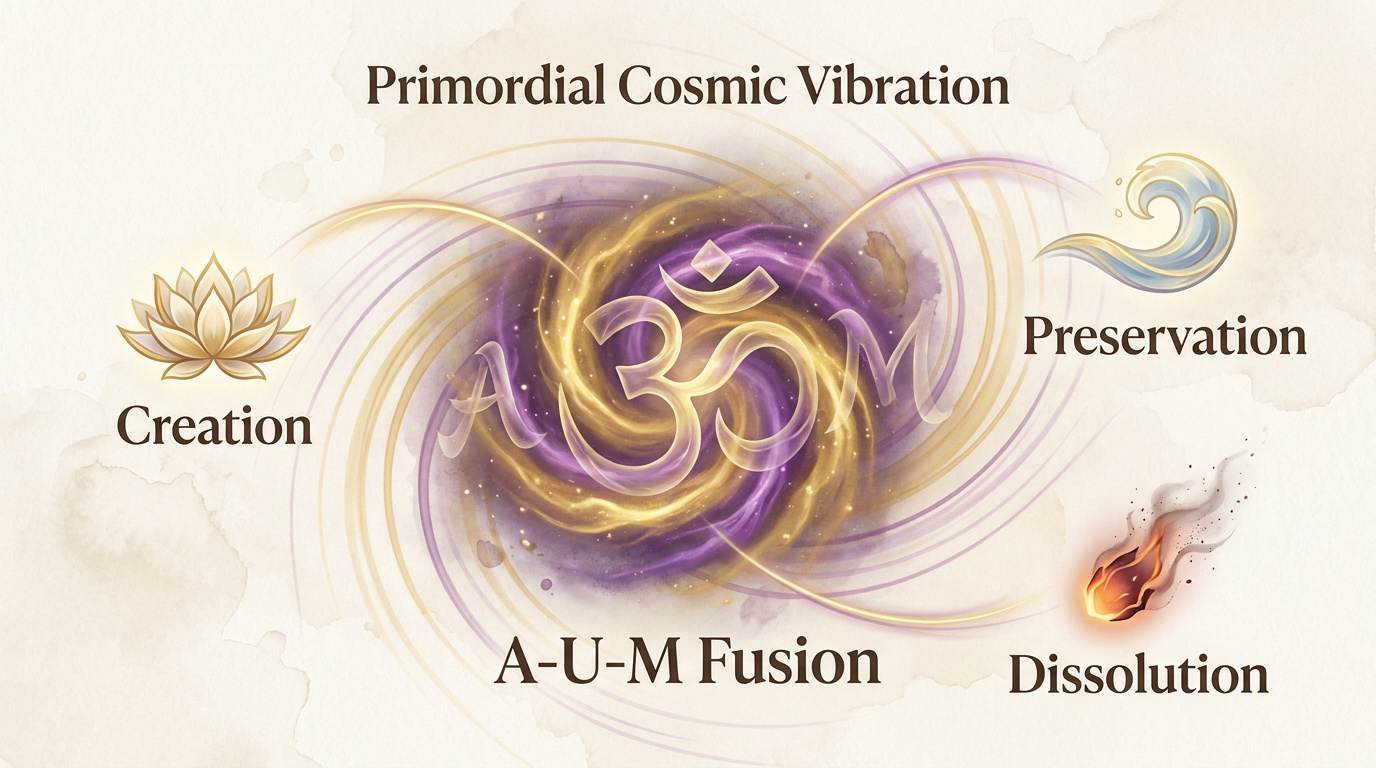
Om represents the primordial vibration of the universe, linguistically merging the sounds A, U, and M. This sacred syllable symbolizes the triad of creation, preservation, and destruction, serving as the foundational mantra across Indian spiritual traditions. This cosmic resonance finds its roots in a precise phonetic structure.
Phonetic Breakdown of the A-U-M Triad
The syllable consists of three distinct vocalizations: A, U, and M. These specific phonemes represent the beginning, middle, and end of all sound. In Sanskrit, they merge into a single O.
The pronunciation has shifted over centuries from ancient Vedic forms to modern usage. This linguistic fusion creates a seamless transition between the three phonemes, as detailed in Om in Indian religion. The sound flows as a continuous breath.
Each individual syllable correlates to a vital phase of existence. The sound A signifies creation, while U represents preservation. Finally, the M denotes dissolution or the destruction of the material form.
Phonetic unity is achieved through this triad. The closing nasal resonance binds the entire vibration together.
Historical Roots in Vedic and Upanishadic Texts
Ancient scriptures first recorded this syllable thousands of years ago. It emerged primarily as a ritualistic tool. Early Vedic liturgy used it to sanctify the start of sacred recitations.
Om serves as the absolute essence of all Vedas. It encapsulates the vast knowledge contained within the three primary Vedic texts. This makes it the most authoritative sound in the tradition.
The term Pranava describes Om as the primeval sound. The Mandukya Upanishad focuses entirely on this syllable. It explains how the sound represents the profound cosmic significance of the Absolute.
Pranava: The primordial sound.
Omkara: The source of all creation.
Udgitha: The chant found in the Chandogya Upanishad.
Akshara: The imperishable and immuable syllable.
Puranic texts show varied sectarian applications. Shaivites and Vaishnavites use the symbol to mark their icons. Each tradition adapts the resonance to its specific spiritual focus.
Philosophical Layers of Consciousness and Reality
Beyond the sounds themselves, the mantra acts as a map for the human psyche and its various levels of awareness.
Scholars trace Om to the Sanskrit “ām” (yes), the root “āp” (to reach), or the proto-indo-european particle “au”.
Navigating the Three States of Human Experience
Human life follows a constant cycle of three distinct states. These include the waking world, the dreaming realm, and deep sleep. Each phase marks a specific cognitive transition in daily life.
The phonetic components of the mantra represent these levels. The sound “A” relates to waking reality. “U” signifies the dream world. “M” corresponds to the silence of dreamless sleep.

This vocal movement mirrors our internal psychological journey. As the sound travels through the mouth, it reflects our passage through these layers. It connects the physical body to deeper consciousness.
The three primary states are:
- Waking state (Jagrat)
- Dreaming state (Svapna)
- Deep sleep state (Sushupti)
Turiya and the Significance of the Fourth State
The silence following the chant defines the ultimate state. This quiet moment is not empty. It remains full of pure awareness and infinite potentiality for the practitioner.
Turiya relates to the realization of the Atman and Brahman. It serves as the underlying reality. This foundation supports and connects the other three states of human consciousness.
Practitioners strive to transcend ordinary awareness through focused meditative chanting. The spiritual goal involves stabilizing one’s presence in this fourth state. Consistent practice helps maintain this elevated state of being.
Turiya is essentially non-dual in its nature. It acts as the unchanging observer. This core consciousness remains steady throughout every experience in a person’s life.
| Phoneme | State of Consciousness | Experience |
|---|---|---|
| A | Jagrat | External Waking World |
| U | Svapna | Internal Dreaming World |
| M | Sushupti | Deep Dreamless Sleep |
| Silence | Turiya | Pure Consciousness |
Visual Representation and Symbolic Geometry
The auditory power of Om finds its physical counterpart in a symbol that serves as a visual guide for spiritual liberation.
Decoding the Curves of the Sacred Icon
The large lower curve identifies the waking state, known as Jagrat. This stroke represents our external sensory world. It is the foundation of our daily conscious experience.
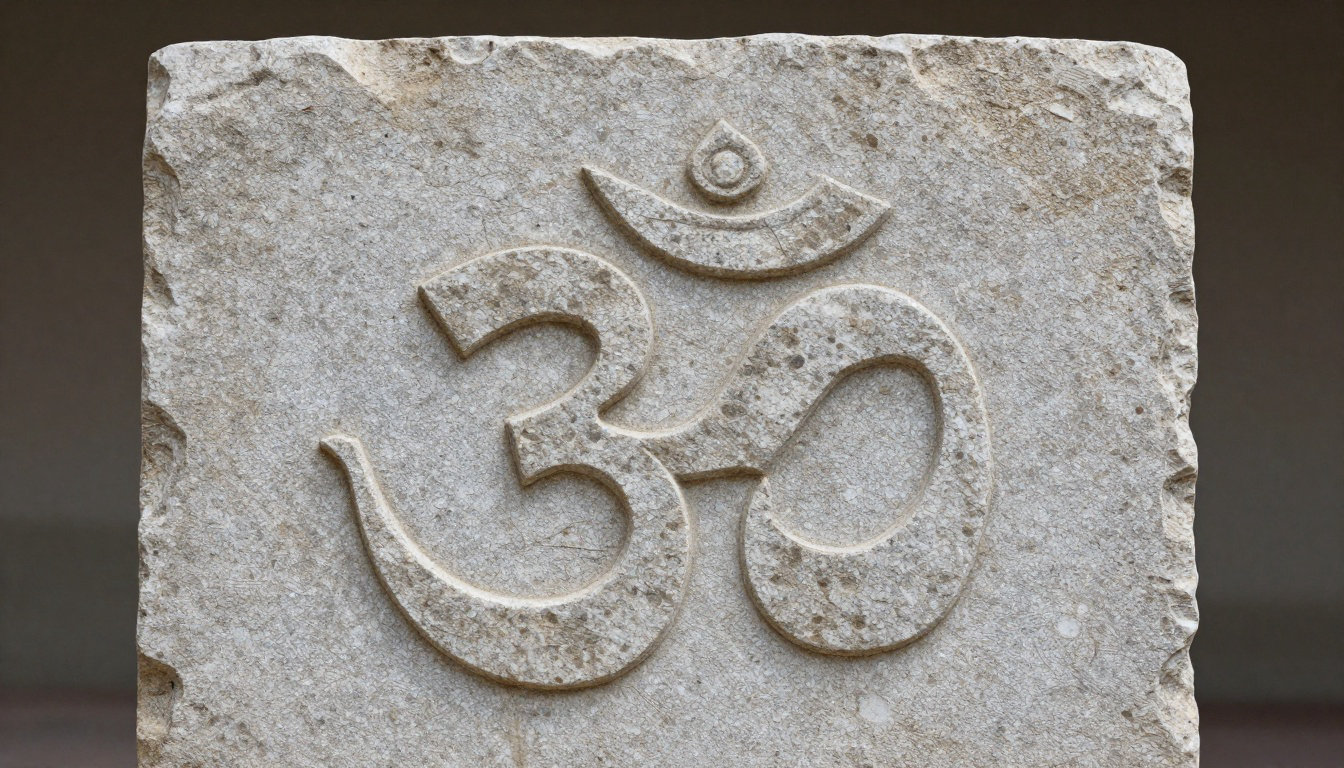
The middle curve signifies the dream state, or Swapna. This element acts as the bridge between our conscious life and the deep subconscious mind. It reflects our internal thoughts.
The upper curve represents the state of deep sleep. Each stroke of the symbol is a deliberate representation of the soul’s journey through different levels of reality. It shows a path toward peace.
| Symbol Component | State of Consciousness | Meaning |
|---|---|---|
| Large Curve | Waking | External sensory world |
| Middle Curve | Dreaming | Subconscious bridge |
| Upper Curve | Deep Sleep | Unconscious rest |
| Crescent | Maya (Illusion) | The veil of perception |
| Dot | Turiya (Absolute) | Pure consciousness |
The Crescent and the Veil of Illusion
The crescent shape represents the veil of Maya. This separator hides the truth from our perception. It keeps the soul bound to the material world and its many distractions.
The Bindu sits above the crescent, representing the highest consciousness. This dot signifies Turiya, the goal of all spiritual practice. It is the point of ultimate unity and peace.
The symbol serves as a map for spiritual liberation. One must pass through the crescent of illusion to reach the singular point of ultimate truth. This journey defines the What is the Om meaning? inquiry.
This visual mark has appeared at the beginning of texts since the 6th century. It continues to signify sanctity today. Its geometry remains a timeless spiritual guide.
Global Spiritual Variations and Distinct Traditions
While rooted in Vedic thought, the resonance of Om has crossed theological boundaries to influence several other major Eastern faiths.
Buddhist and Jain Perspectives on the Mantra
Buddhist traditions utilize the sound differently than Hindu practices. It serves as a prefix in mantras to invoke deep compassion. This focus helps practitioners center their minds during meditation.
In Jainism, the syllable represents a five-fold salutation. It stands for the initials of five supreme beings. These beings occupy the highest levels of their spiritual hierarchy.
The sound remains a shared tool for centering the spirit. Diverse theological nuances exist across these faiths. Yet, the accessibility of the vibration remains universal for all seekers.
Ceremonies often incorporate this sacred syllable Om to elevate the ritual. It purifies the environment in both Buddhist and Jain monastic settings.
| Tradition | Primary Meaning |
|---|---|
| Hinduism | Essence of Brahman and Cosmic Reality |
| Jainism | Initials of the Five Supreme Beings |
| Buddhism | Mantra Prefix for Focus and Compassion |
| Sikhism | Ik Onkar representing One Creator |
Distinguishing Om from the Sikh Ik Onkar
Ik Onkar holds a specific meaning within the Sikh tradition. It emphasizes the absolute oneness of the Creator. This principle defines the supreme and only reality for Sikhs.

Sikhism maintains a strict monotheistic focus compared to Vedic interpretations. They share a linguistic root in the sound. However, their theological applications differ quite significantly in practice.
Visual similarities often lead to common misconceptions about their origins. Many observers confuse the two symbols at first glance. Sikhism rejects the polytheistic associations sometimes found in other ancient interpretations.
Understanding the distinction is vital for grasping What is the Om meaning? across different cultures. Here are the primary differences in focus:
- Vedic Om (Cosmic Vibration)
- Sikh Ik Onkar (One Creator)
- Buddhist Om (Mantra Prefix)
Practical Resonance and Scientific Impact
Understanding the philosophy is one thing, but the true power of Om is felt through direct physical practice and vibration.
Techniques for Effective Meditative Chanting
Start with a deep inhale. Allow the sound to flow naturally from the diaphragm. This foundation ensures a stable and powerful vocalization.
Feel the vibration rise through the chest. It moves from the navel up to the throat. Finally, let the resonance end at your lips.
Chanting traditionally occurs at the start of yoga. It also concludes the session to ground energy. This practice helps create a dedicated sacred space.
Observe the final silence. This pause is vital. It allows the meditation to take root.
- Deep inhale: Breathe from the diaphragm to support the sound.
- Vocalize A-U-M: Let the three syllables blend into one continuous flow.
- Internal movement: Feel the vibration rise from the navel to the crown.
- Nasal hum: End the sound at the lips with a resonant “M”.
- Silent observation: Sit in the stillness that follows the vibration.
Biological Effects of Sound Vibration on the Brain
Modern research explores the 432 Hz frequency. Some suggest this resonance aligns with natural rhythms. It may influence the nervous system’s overall balance.
The “M” hum calms the vagus nerve. This vibration stimulates the parasympathetic nervous system. Consequently, it helps in reducing stress and anxiety levels.
Repetitive sound immersion offers psychological benefits. Chanting leads to increased focus during the day. It effectively decreases the mental chatter that disrupts daily peace.

What is the Om meaning? It is a physiological tool for health.
- Stress reduction
- Vagus nerve stimulation
- Enhanced mental clarity
By understanding the Om meaning as the cosmic triad of creation, preservation, and dissolution, you can align your consciousness with the universal vibration. Master this sacred sound through daily chanting to stimulate your nervous system and transcend the veil of illusion. Start your practice now to achieve lasting mental clarity and spiritual peace.