Vrschikasana, popularly known as the scorpion pose, was notably absent from medieval Hatha Yoga texts until B.K.S. Iyengar documented it in the 20th century. This advanced inversion requires a precise combination of forearm stability and spinal extension to mirror the striking silhouette of a scorpion.
Practitioners often struggle to maintain the necessary equilibrium while attempting to arch the feet toward the head. This article examines the anatomical requirements and preparatory stages to help you master this complex posture with control and safety.
- Vrschikasana and the Origins of the Scorpion Pose
- 4 Preparatory Poses for Shoulder and Core Strength
- How to Execute the Transition from Dolphin to Scorpion?
- Anatomical Focus on Spinal Flexibility and Muscle Engagement
- Safety Protocols and Wall-Assisted Progression Stages
- 3 Energetic Benefits and Advanced Variation Pathways
Vrschikasana and the Origins of the Scorpion Pose
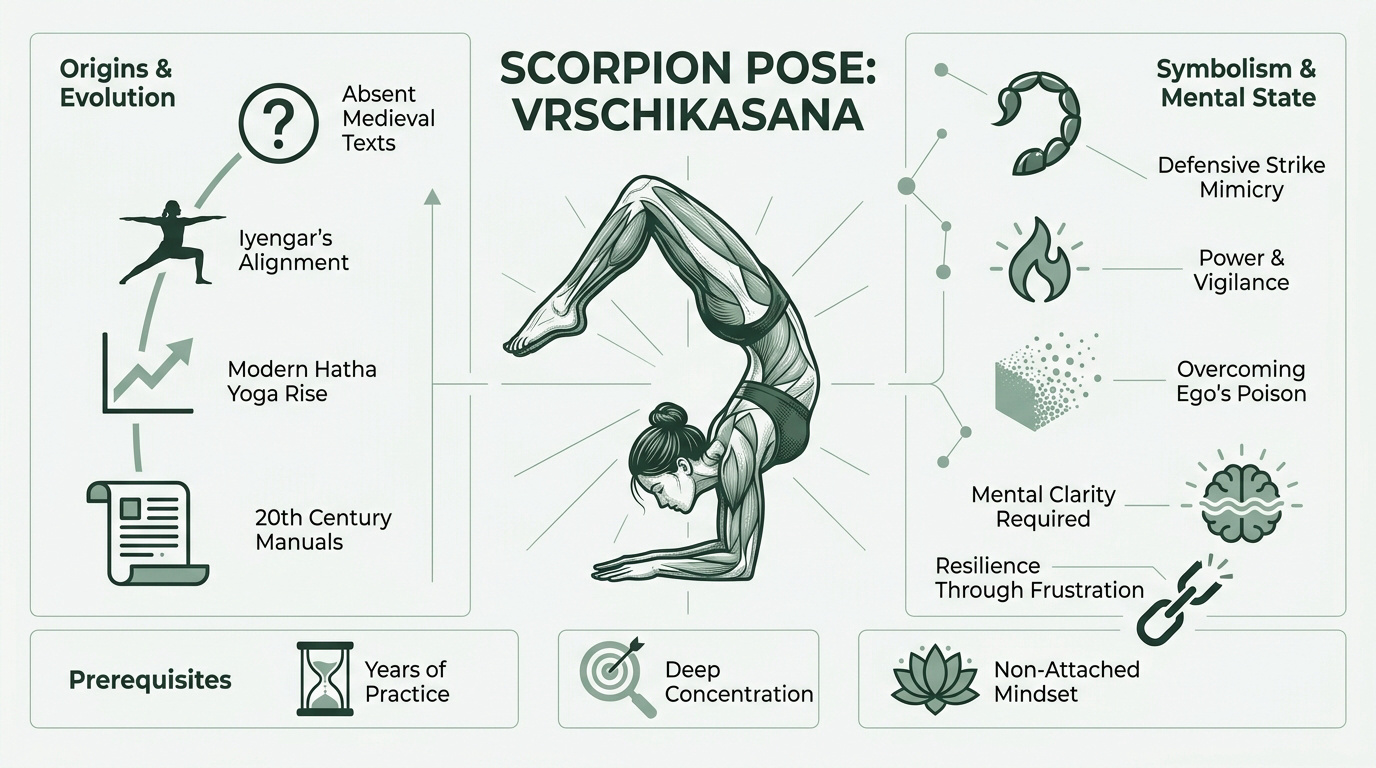
Vrschikasana, or Scorpion Pose, demands elite forearm stability and spinal extension. While absent in medieval texts, B.K.S. Iyengar popularized this advanced inversion, which mirrors a scorpion’s strike to build intense psychological resilience and physical power.
From the Sanskrit ‘Vrschika’ (scorpion) and ‘Asana’ (pose). A posture where the body mimics a scorpion’s strike, requiring forearm balance and deep spinal extension.
Transitioning from foundational balances to this peak asana requires a clear understanding of its historical development and structural requirements.
Historical Evolution in Modern Hatha Yoga
Vrschikasana roots are firmly planted in 20th-century yoga manuals. This complex posture gained significant traction within modern postural yoga circles during the mid-1900s, marking a shift in practice.
B.K.S. Iyengar played a pivotal role in refining the pose’s alignment. His systematic methodology in “Light on Yoga” transformed this advanced inversion into an attainable goal for dedicated practitioners worldwide.
Interestingly, Vrschikasana is entirely absent from medieval scripts like the Hatha Yoga Pradipika. Ancient practices focused on static holds, whereas modern yoga embraces these more dynamic and anatomically challenging evolutions.
Symbolism of the Scorpion’s Defensive Strike
The visual form of the pose directly mimics a scorpion’s tail. As the feet arch gracefully toward the head, they represent a stinger poised and ready for a defensive strike.
This shape symbolizes a state of constant vigilance and inner power. Practicing the pose helps individuals overcome the metaphorical “poison” of the ego through rigorous physical and mental discipline.
The physical scorpion pose reflects a specific mental state where the strike is directed inward. This internal action aims to destroy ignorance, as reflected in the traditional Vrischikasana terminology and philosophical teachings.
Mental Prerequisites for Advanced Inversions
Mastering such a balance requires immense personal discipline. Practitioners must cultivate deep patience, often dedicating years of preparation before attempting the full expression of the pose.
Mental clarity is indispensable for maintaining concentration while inverted. The brain must stay quiet and calm, even as the body navigates the high-stress demands of a forearm balance.
Resilience is vital when facing the complexity of this movement. One must accept the frustration of falling, maintaining a non-attached mindset throughout the long and challenging learning process.
4 Preparatory Poses for Shoulder and Core Strength
Mastery of the Scorpion starts long before the feet leave the ground, beginning with foundational strength in the shoulders and trunk.
Building Stability Through Dolphin Pose
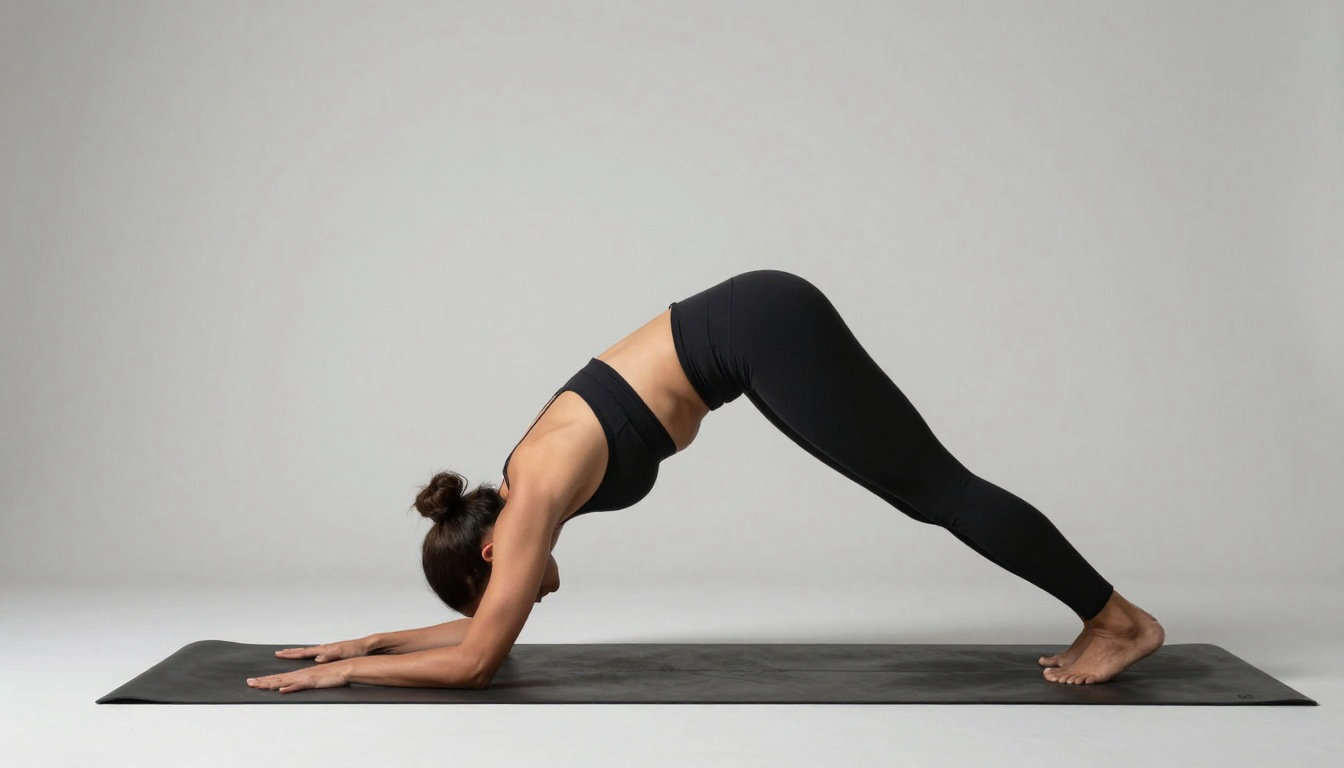
Use Dolphin Pose to strengthen the shoulder girdle. This builds the specific muscular endurance needed for forearm weight-bearing. It acts as a primary conditioning step for the upper body.
Work on the alignment of forearms and elbows. Keep them parallel to prevent the base from collapsing outward. This stability is vital for maintaining balance during the inversion.
Keep forearms parallel and avoid letting elbows splay wider than shoulders to maintain a stable base for the eventual inversion.
Prepare the shoulders to support the body’s full weight. Activating the muscles around the scapula ensures the joints remain protected and stable. Focus on these key actions:
- Pressing through the forearms
- Lifting the hips high
- Engaging the serratus anterior
Opening the Thoracic Spine with Wheel Pose
Practice Wheel Pose for spinal mobility. It targets the mid-back area that often remains stiff. This extension is a prerequisite for the deep curve of Vrschikasana.
Stretch the anterior chain and open the chest. This creates space for the deep backbend. It also helps in releasing tension stored in the pectoral muscles.
Foster the dorsal extension necessary for Scorpion. Professional guidance often suggests that backbend positions are essential prerequisites for this level of flexibility. Without this thoracic opening, the lower back takes too much pressure.
Core and Glute Activation for Spinal Protection
Engage deep abdominal muscles for stability. The transverse abdominis acts as a natural corset for the spine. This internal support prevents unnecessary wobbling when you are upside down.
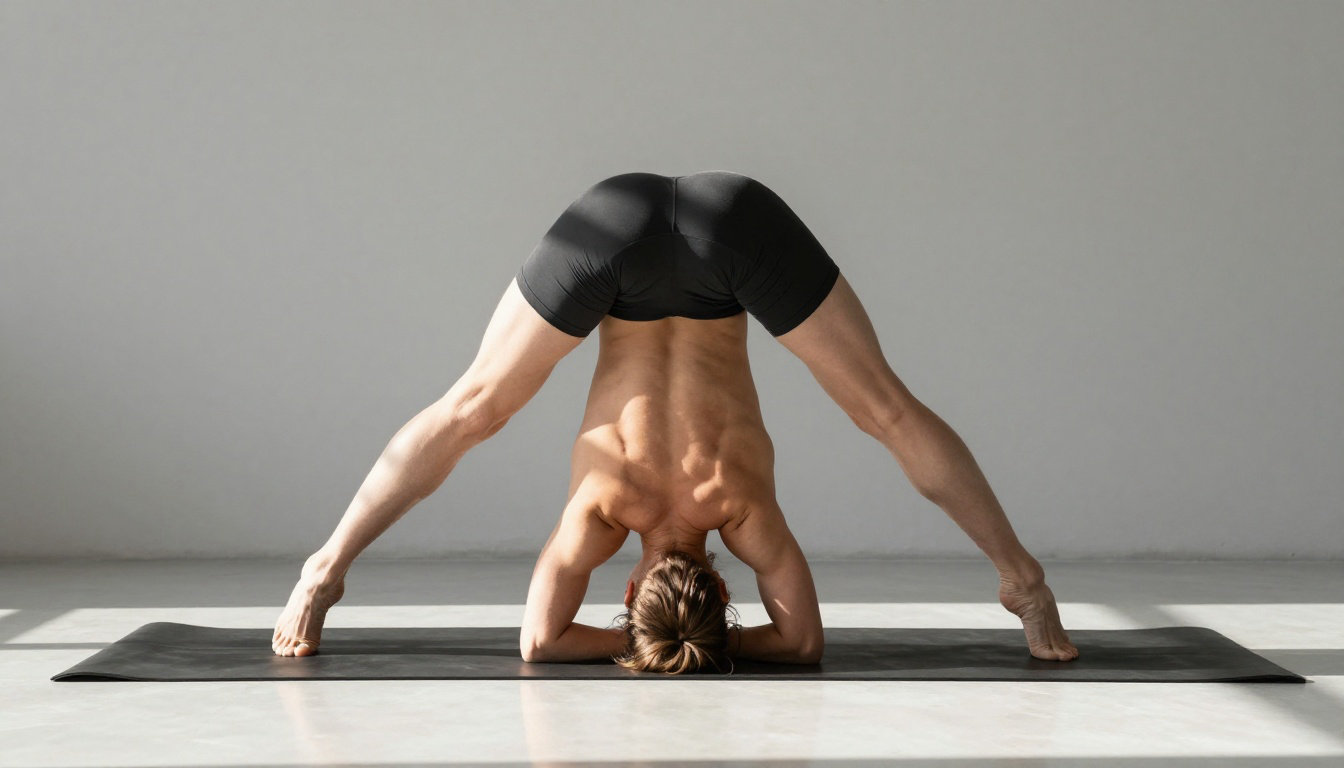
Activate the glutes to support the lower back. This prevents the pelvis from dumping forward. Strong gluteal engagement provides the necessary counter-balance to the weight of the legs.
Avoid excessive lumbar compression during the arch. Focus on length rather than just depth to keep the vertebrae safe. Think about reaching the crown of the head away from the tailbone to maintain space in the scorpion pose.
How to Execute the Transition from Dolphin to Scorpion?
Once the strength is established, the movement becomes a precise dance of shifting weight and controlled extension.
Establishing a Solid Forearm Balance Foundation
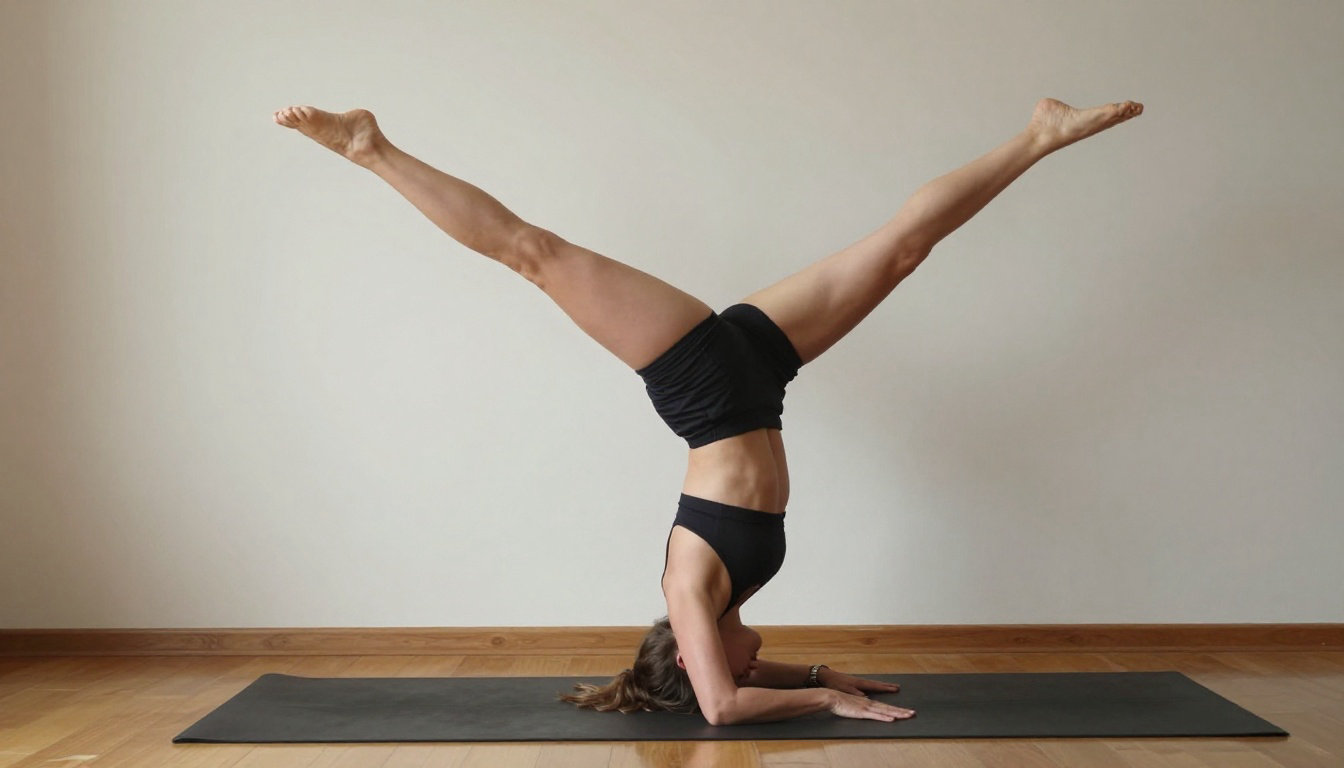
Master Pincha Mayurasana before attempting the extension. A vertical forearm stand is the non-negotiable starting point for Vrschikasana. You must feel completely stable before moving.
Check elbow width under the shoulders. Ensure the elbows do not splay wider than the armpits. This alignment is vital for skeletal support.
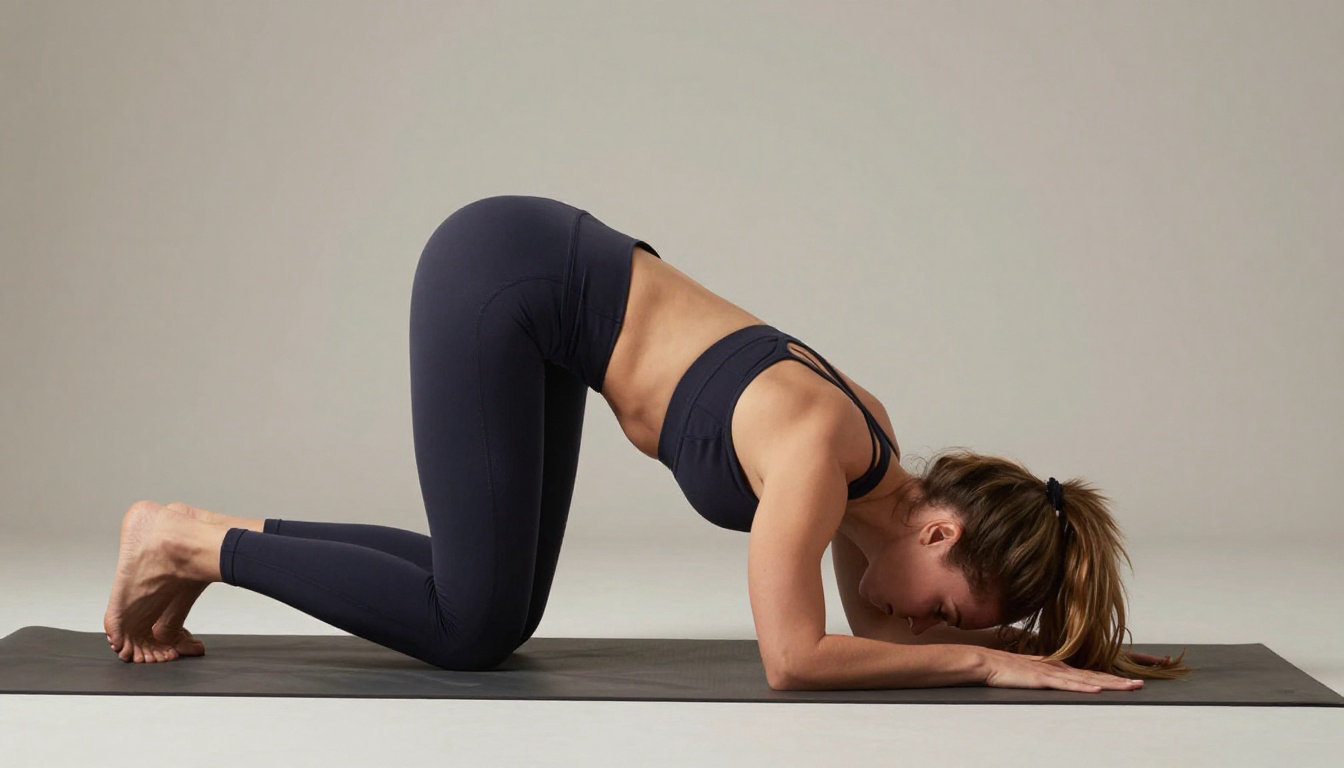
Maintain a stable base and active ground push. The forearms must “claw” the mat to maintain total control. This active engagement prevents the weight from collapsing into the joints.
Shifting the Center of Gravity for the Backbend
Move the chest forward to counterbalance the hips. This subtle shift prevents you from falling back toward the floor. It creates the necessary space for the spine to curve.
Initiate knee flexion with control and slowness. Avoid kicking or jerky movements that break the balance. Smooth transitions are the hallmark of an advanced scorpion pose practice.
Coordinate leg movement with heart opening. As the feet drop, the sternum must reach forward to maintain the equilibrium. This dual action keeps the center of gravity over the base.
Refining the Gaze and Head Positioning
Direct the gaze (Drishti) to stabilize balance. Look slightly forward between the thumbs rather than straight down. Specifically, focusing on the tip of the nose (Nasagre) can ground your attention.
Adjust neck position to avoid cervical tension. Keep the back of the neck long even while looking forward. Compression in the cervical spine will only lead to discomfort and instability.
Manage breathing during the deep extension phase. Smooth, steady inhalations prevent the ribs from locking up. Controlled breath ensures that the nervous system remains calm during this intense physical demand.
Anatomical Focus on Spinal Flexibility and Muscle Engagement
Understanding the mechanics behind the pose allows for a safer and more efficient engagement of the primary movers.
Primary Muscle Groups in Weight Distribution
The triceps and deltoids play a central role. These muscles work overtime to keep the humerus bone stable in the socket. This prevents shoulder collapse.
Erector spinae engagement is equally vital. These muscles facilitate the deep arch along the entire column. They provide the necessary strength to sustain the backbend safely.
Forearms act as the foundation, providing a stabilizing function. They distribute weight evenly to prevent tipping. Proper engagement ensures the scorpion pose remains controlled and steady throughout the hold.
| Muscle Group | Primary Action in Scorpion | Importance (1-5) |
|---|---|---|
| Triceps | Stabilize humerus and arm extension | 5 |
| Core (Abs) | Balance and lumbar protection | 5 |
| Glutes | Support the backbend and hips | 4 |
| Erector Spinae | Facilitate the spinal arch | 4 |
| Serratus Anterior | Lift and stabilize the shoulders | 5 |
Breath-Body Connection as a Stabilizing Mechanism
Use diaphragmatic breathing to anchor the pose. Deep breaths create internal pressure that supports the lumbar spine. This technique protects the lower back during the deep extension.
The exhale helps deepen the arch. It allows the front body to soften and expand. This relaxation of the chest facilitates a more pronounced curve.
Maintain a constant airflow to avoid rigidity. Holding the breath creates tension that leads to a quick loss of balance. Rhythmic breathing keeps the nervous system calm and focused.
Overcoming the Psychological Fear of Falling
Address the apprehension linked to deep backbends. The fear of the unknown behind you is a major mental hurdle. Acknowledging this instinct is the first step toward mastery.
Develop visualization techniques for balance. Imagine your body as a strong, flexible arc of light. This mental image helps align the physical form with the intended shape.
Learn to fall safely to gain confidence. Knowing how to tuck and roll or “bridge out” removes the mental block of injury. Mastery of the exit makes the entry much easier.
Safety Protocols and Wall-Assisted Progression Stages
Safety isn’t just a suggestion; it is the framework that allows for long-term progression without setbacks. Mastering the scorpion pose requires a disciplined approach to physical readiness and environmental support.
Avoid this pose if you have: high blood pressure, glaucoma (due to intraocular pressure), or existing injuries to the wrists, elbows, shoulders, neck, or herniated discs.
Identifying Contraindications and Injury Risks
Certain medical conditions like glaucoma make inversions risky. The increased intraocular pressure during these poses can be dangerous for some individuals. Always prioritize ocular health before attempting deep extensions.
Warn about risks for herniated discs. Intense spinal extension can exacerbate existing vertebral issues. Proper spinal health is a prerequisite for this advanced movement.
Specify limits for high blood pressure. Inversions significantly alter blood flow and should be cleared by a doctor. This ensures your cardiovascular system can handle the shift in pressure.
Wall-Supported Drills for Safe Progression
Use the wall to measure head-to-foot distance. This provides a tactile feedback loop for how deep your arch actually is. Knowing your spatial limits prevents overextension.
Practice controlled climbs with back support. This builds the strength to hold the weight without the fear of flipping. The wall acts as a reliable safety net during these repetitions.
Develop muscle memory without falling risks. This stage allows the nervous system to adapt to the inverted orientation while maintaining total control.
- Walking feet down the wall
- Holding the “half-scorpion”
- Using the wall to kick off gently
Strategic Use of Yoga Blocks and Straps
Place a block between the hands for arm alignment. This forces the index fingers to stay parallel and active. It creates a solid foundation for the entire upper body.
Use a strap to prevent elbows from splaying. Loop it just above the elbows for a stable frame. This restriction ensures that the weight remains centered over the forearms.
Optimize structural stability with props. These tools allow the body to experience the pose’s geometry before the strength is fully there. They bridge the gap between preparation and mastery.
3 Energetic Benefits and Advanced Variation Pathways
Beyond the physical struggle lies a profound energetic shift that rewards the practitioner’s dedication.
Activation of the Upper Energy Centers
The scorpion pose creates a powerful connection to the Throat and Third Eye chakras. This deep extension stimulates the flow of energy through these vital upper centers during the hold.
The stretching of the neck area specifically targets the thyroid gland. This physical stimulation can help balance metabolic functions through the consistent practice of the extension.
This inversion flushes the upper body with fresh oxygen and nutrients. Improved blood flow to the brain enhances concentration and provides a sense of mental clarity after the posture.
Transitioning to Scorpion Handstand Variations
Moving from forearms to palms represents the ultimate stage of this balance. Transitioning to a handstand requires significantly more wrist and shoulder control than the standard version.
Forearms offer a larger base for stability during the backbend. Hands allow for more height but demand a much finer sense of equilibrium to maintain the shape.
Always neutralize the spine after such a deep backbend to prevent stiffness. Practitioners should transition into sequences leading to Balasana or Shavasana for proper recovery and integration.
- Start in Dolphin Pose (Catur Svanasana).
- Press elbows and engage the core.
- Walk feet in toward the elbows.
- Align shoulders directly over elbows.
- Lift into Pincha Mayurasana.
- Stabilize the forearm balance.
- Shift hips and chest to create the arc.
- Bend knees toward the head.
- Hold the pose with steady breath.
- Return to Pincha Mayurasana.
- Relax in Child’s Pose.
Long-Term Progression and Practice Timing
Morning practice often encounters natural body stiffness but benefits from high energy levels. Evening sessions typically provide more flexibility, though the mind may be more fatigued.
Advanced practitioners should establish a plan focusing on hold times. Quality of breath remains the primary indicator of progress rather than the depth of the curve.
Integrate compensation poses to balance the spine and release tension. These specific postures ensure the back remains supple and healthy over time:
- Child’s Pose (Balasana)
- Supine Twist
- Forward Fold (Uttanasana)
Mastering Vrschikasana requires elite forearm stability, spinal flexibility, and the mental resilience to overcome the ego. By integrating these preparatory drills and safety protocols, you will soon transform your practice. Begin your journey toward this advanced forearm balance today to unlock profound physical power and spiritual clarity.